Above are Satellite Images taken of the Hudson River in 2010 and 2011, respectively.
Get ready for more of the same. More rain and more snow are on their way to the northeast. You don't have to be a meteorologist to understand that global warming causes incredible increases in precipitation, especially in temperate climates - and leaves behind great drought in warmer areas (see Texas). Heat causes greater evaporation, and more precipitation, and this past summer, according to NOAA, was the second hottest summer on record in the U.S.
I was fortunate enough to catch one of the last flights out before Hurricane Irene (we flew out of Philly to France for holiday the day before the big storm hit - New York airports were already closed), so I wasn't here to see it. We were very luck that our Hoboken property stayed dry as well. But I can tell by the Hudson River that Irene, and the subsequent Tropical Storm Lee, caused great damage.
A week later, the Hudson still flows muddy brown. The Hudson River Valley has swelled to great heights. And run-off pollutants will continue to threaten our waterway for weeks to come.
I hope to get back in my boat before the cold weather kicks in - maybe this weekend. Of course, the approaching Tropical Storm Maria might change my minds. It's just more of the same.
Above are a few of the photos from my vacation with family and friends in Le Vernet, France. Baby Paddler loved it. Thank you to Ash, Brittany, and Andy for a great week.
After a Harlem fire dumped raw sewage into our Hudson River, the NJ DEP has stated the river has been cleared again for recreational use. Read more here. To read more about how the damage has already been done, read here.
I am not sure what the laws are regarding mooring or tying up boats in Weehawken Cove, but lately, there seem to be many. Last year, there were only a few - all belonging to a New York boat club. This year, there are twice as many - most of which are in bad condition and have been poorly moored, anchored, or tied up. Above is a picture of one such boat that has been seen in the cove lately. The boat is haphazardly tied to a pole on the collapsing pier east of the Tea Building. Now take a look at the same boat below.
The above picture was taken only two days later. The boat, filled with personal belongings, is now sunk against the pier.
Worse yet, the boat's belongings are strewn across the Tea Building beach (below).
Now, I am all for the right to waterfront access. It is my opinion, the more people enjoy the Hudson River, the more people will protect it. But boats recklessly tied to collapsing docks or moored by homemade anchors only threaten our beautiful river. Further, we do not know if people are/were living on these watercrafts.
I am amazed that Hoboken and/or Weehawken authorities have allowed all of these boats to just tie up anywhere. (By the way, I have noticed that many of them have come along since the new construction of the waterfront walkway between the two river-front cities. Do the boats belong to the workers? I know the same boat, shown above, was tied up to the newly constructed walkway only weeks ago.) It is my hope that boats like the one above will not be allowed to stay in Weehawken Cove any longer.
Otherwise, I might just have to buy that sailboat I wanted. After all, I know the perfect place to put it.
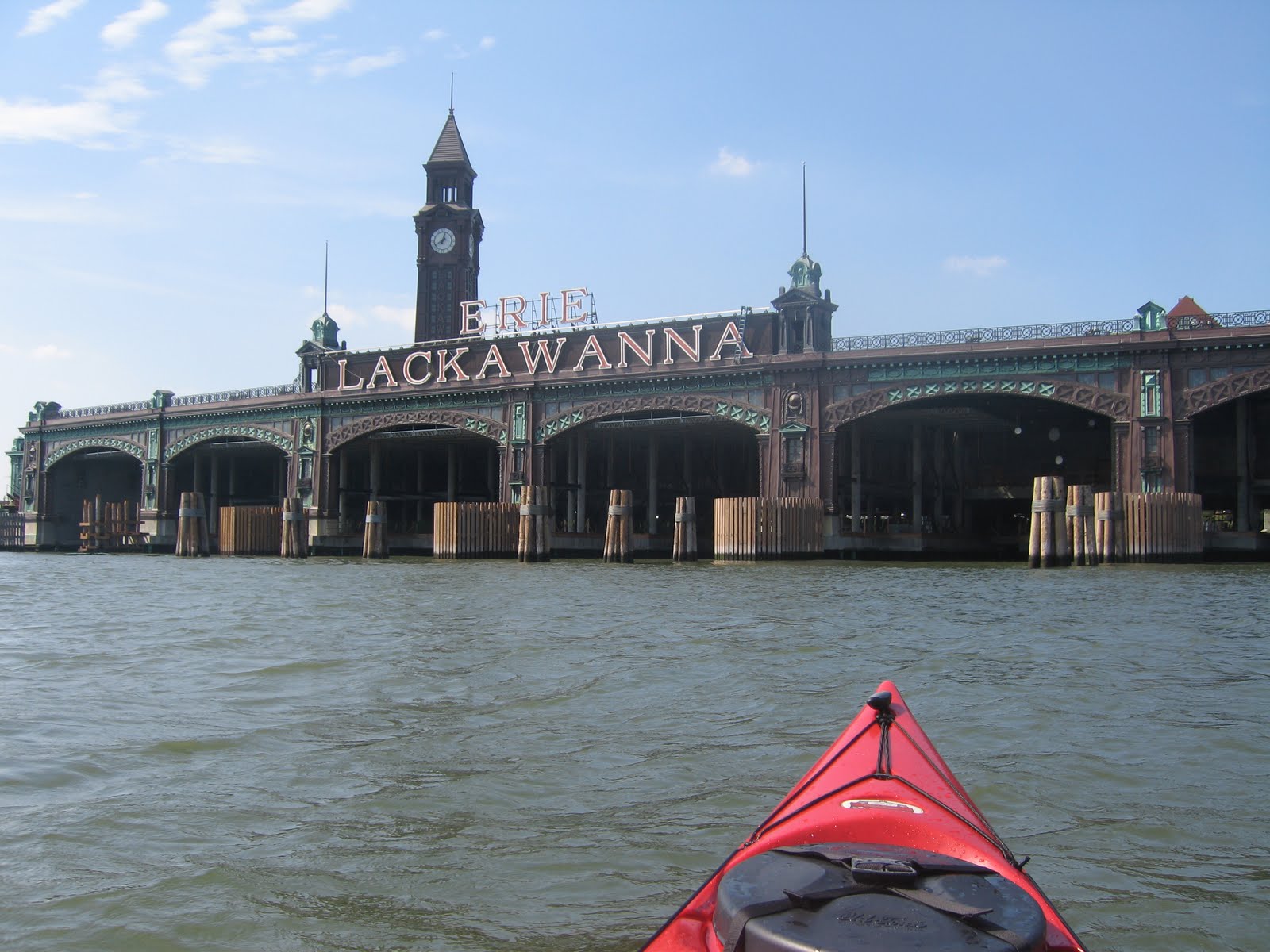
I love paddling down to the Lackawanna ferry terminal. Each time I do, I am amazed by the restoration of this historic building. You can now see awnings have been added, as well as shiny, round decorative mirrors hanging from the ceiling.
I'm curious, with the construction of, not one, but six terminals, is the city of Hoboken anticipating greater ferry usage by Hobokenites? Is NY Waterway going to be increasing their capacity? Or, is the city of Hoboken anticipating other private-use ferry services? Maybe they will, once again, sail the Yankee Clipper - the ferry from Hoboken to Yankee Stadium? Either way, things are looking great downtown.
These images were all taken below the sinkhole near Fouteenth Street Pier. I know this story has been discussed ad nauseum in the local press, but until you see for yourself just how much cement sits atop old wooden pylons, it is hard for the average Hobokenite to understand how bad the situation really is.
Fleet week usually brings large military ships to New York's harbor, but this is not a Navy ship. This is simply the largest private boat I have seen in the Hudson. Check out the size of the craft and its three masts compared to the pleasure boat that is next to it. If anyone knows anything about this boat, please comment.
I paddled over to to the Twelfth Street Pier the other day. To my surprise, in addition to the historic Yankee Ferry that is always there, there were two other boats tied to the dock. One who is making a return visit and one that I had never seen before. The Anne is back (pictured in front). You remember this boat - its controversial Captain, Reid Stowe, spent a remarkable 1,152 days at sea. It left for winter , but has returned. Read more about this amazing ship here. The other boat was enormous! It flew flags from Denmark and had a large crew drinking wine and enjoying dinner when I paddled by. They all seemed very friendly and waved.
These ships add much needed character to our waterfront. I suggest you stop by to check them out before they sail off.
Since the birth of Baby Paddler, I haven't been able to log as many hours on the Hudson as I did in the past. I have gotten out enough, though, this summer to enjoy the river and take a few pictures. Here are a couple that have been on my camera for a while:
A pleasure boat sunk in Weehawken Cove.
Invasion of the paddle boarders.
New Hoboken Green Space? It is as usable right now as Pier C...
Pier C. Will this ever open?
Progress on the Steven's Institute of Technology waterfront.
What in the world? The Sheraton in Weehawken.
And finally, a picture of the "Anne"- possibly one of the most famous ships to dock on our waterfront. Read more about this remarkable ship and its captain here (from last week's New York Magazine). My friend Steve said it well... "he (the captain) is right in what he doesn't quite say... he deserves more fanfare and recognition." However, as a new father, the story is tough to swallow. From what I've heard, this ship is now docked in Queens.
As a Hudson River kayaker I am often asked “is the water clean?”To date, my response has always been “yes”, though I could not provide evidence to support my answer.The following study was done to help answer that question conclusively as well as satisfy my own curiosity.
Materials and Methods
The following experiments were conducted using a LaMotte Water Monitoring Kit.The kit provided all materials and procedures for testing temperature, coliform, dissolved oxygen, biochemical oxygen demand, nitrate, pH, phosphate, and turbidity.The samples for each test were taken from the mouth of the Hudson River inlet between Weehawken and Hoboken (approximately 200 meters north of the end of the northern-most, collapsing pier in Hoboken).The Hudson River water sample was taken at 3:53pm on ThursdayJuly 29th.The air temperature at the time the sample was 28 degrees C (approximately 83 degrees F).The sample was taken approximately two and a half hours after high tide.There had not been a significant rainfall in the 48 hours prior to sampling.The sample was obtained in a large sterile container held under the water’s surface for 30 seconds.
Temperature Test
Temperature is very important to water quality.Temperature affects the amount of dissolved oxygen in the water as well as the rate of photosynthesis of aquatic plants.Thermal pollution, the discharge of heated water, can cause temperature changes that threaten the balance of aquatic systems (LaMotte Manual).
Coliform Bacteria Test
Fecal coliform are naturally present in the human digestive tract, but are rare or absent in unpolluted waters.The presence of coliform bacteria is a reliable indication of sewage in the Hudson River.Although
coliform bacteria are not pathogenic, they are dangerous to human health.This test indicates total and all coliform bacteria strains present.This test kit will indicate above or below 20 coliform colonies per 100ml of river water (LaMotte Manual).
Dissolved Oxygen Test
All aquatic animals need oxygen to survive. Natural waters with consistently high dissolved oxygen levels are most likely healthy and are capable of supporting a diverse aquatic environment.Cold water holds a greater amount of dissolved oxygen than warm.High levels of bacteria from sewage pollution or large amounts of rotting plants can cause dissolved oxygen to decrease (LaMotte Manual).
Biochemical Oxygen Demand Test
Biochemical oxygen demand is a measure of the quantity of dissolved oxygen used by bacteria as they break down organic wastes. In slow moving or polluted rivers, much of the available dissolved oxygen is consumed by bacteria, robbing other aquatic organisms of the oxygen needed to live (LaMotte Manual).
Nitrate Test
Nitrogen is essential for plant growth but the presence of excessive amounts in water supplies presents a major pollution problem. Nitrogen compounds that may enter water as nitrates, or be converted to nitrates, can originate from agricultural fertilizers, sewage, industrial and packing house wastes, drainage from livestock feeding areas, and farm manures. Nitrates, in conjunction with phosphates, stimulate the growth of algae with all of the related difficulties associated with excessive algae growth (LaMotte Manual).
pH Test
pH is a measure of hydrogen ions in solution.Most natural waters will have pH values from pH 5.0-8.5. Acidic, freshly fallen rain water may have a pH value of pH 5.5-6.0 (commonly referred to as acid rain due to pollution). If it reacts with soils and minerals containing weak alkaline materials, the hydroxyl ions will increase and the hydrogen ions decrease; the water may become slightly alkaline with a pH of pH 8.0-8.5. Sea water will have a pH value close to pH 8.0. Waters more acidic than pH5.0 and more alkaline than pH8.5-9.0 should be viewed with suspicion. Mine drainage and acid industrial wastes are the principal factors in increasing the acidity of water, and alkaline industrial wastes are the cause of high pH values (LaMotte Manual).
Phosphate Test
Phosphorus is an important nutrient for aquatic plants and is fundamental in metabolic reactions. The amount found in water is generally not more than 0.1 ppm unless the water has become polluted from waste water sources or excessive drainage from agricultural areas. When phosphorus is present in excess of the concentrations required for normal aquatic plant growth, a process called eutrophication takes place. This creates a favorable environment for the increase in algae and weed nuisances that produce scums and odors. When algae cells die, oxygen is used in the decomposition and fish kills often result. Rapid decomposition of dense algae scums with associated organisms give rise to foul odors and hydrogen sulfide gas. Inorganic phosphate, which is largely the form of phosphorus required for plant growth, is determined by its reaction with a molybdate solution to form a phosphomolybdate which, when reduced, forms a blue color which is the basis for a very sensitive test for phosphorus. The production of more than a faint blue color in this test is cause for suspicion of phosphate pollution (LaMotte Manual).
Turbidity Test
Turbidity is the measure of the relative clarity of water.Turbid water is the result of suspended matter such as clay, silt, and organic matter.Turbidity should not be confused with color since darkly colored water can still be clear and not turbid.Turbid water may be the result of soil erosion, urban runoff, algal blooms, and, in the case of the Hudson River, bottom sediment disturbances (LaMotte Manual).
Results
Water temperature – 27 degrees C (approximately 80 degrees F)
Coliform bacteria – positive, above 20 coliform bacteria colonies per 100ml of water.
Dissolved oxygen – 8ppm at 27 degrees C equals a dissolved oxygen rate of over 99%
Biochemical dissolved oxygen – 0ppm
Nitrate – 5ppm
Phosphate - >1ppm
pH – 7
Turbidity- dark disk visible, 0 to 40 JTU
Analysis
Water temperature – the above average temperatures air temperatures of the Hudson River Watershed are effecting the water temperatures slightly.The Hudson River temperature is slightly above average for this time of year.
Coliform bacteria- The study’s confirmation of fecal coliform colony countshigher than 20 per 100ml of Hudson River Water is the most concerning.The study cannot conclude the cause of the fecal coliform levels, but raw sewage contamination should not be ruled out. Rank - Poor
Dissolved oxygen (DO)- A high level of dissolved oxygen is a positive indicator for a healthy watershed.A result over 99% is a very positive sign for the Hudson River.Rank – Excellent
Biochemical dissolved oxygen (BDO)- The BDO is the difference between the DO and the BOD over a five day period. There was no change in the coloration confirming a BOD of 0ppm. Rank - Excellent
Nitrate- a low result for nitrates is a positive sign for a watershed.This study’s result of 5ppm is a moderate result for the Hudson River.Rank - Fair
Phosphate- like nitrates, a low result for phosphates is necessary for a healthy watershed.>1ppm is an excellent result for the Hudson River.Rank – Excellent
pH- There are many more accurate ways of measuring pH than what was utilized in this study.The brackish water of the Hudson River tested slightly alkaline, but well within norms.Rank – Good to Excellent
Turbidity- a lower turbidity equals a higher clarity of water.Rank – Good to Excellent
Application
The test results conclude that there are many positive signs for the Hudson River.The Hudson River ranks fair to excellent in all tests, except one, that help indicate a healthy river.The fecal coliform test is cause for concern.All tests should be duplicated.Further testing for fecal coliform will be necessary.
Discussion
The clean up the Hudson River has been underway for many decades.Many people, however, remain skeptical that the Hudson River is clean enough for recreation activities such as swimming, boating, and fishing.At one point, the Hudson River was one of the most polluted waterways in the world.This is no longer true.As this study proves, there are many positives signs of the health of the Hudson.I was pleasantly surprised by the number of “excellent” results this study obtained.Though there is much work to do (I was not surprised by the poor coliform result), I hope this study gives people the confidence to enjoy our river more - to get into that sailboat or kayak, or enter the NYC triathlon.The more people use the Hudson, the more they will take an interest in caring for it.
It has been a while since my last post. Unfortunately, numerous family issues have kept me from both my boat and my laptop, but after a difficult Spring, I am hopeful for a wonderful summer. After all, this summer will bring, among other things, Baby Paddler. Needless to say, my wife and I are very excited.
I have been in the boat quite a few times, mostly to relax, but I have numerous ideas for future posts.
The question that I am asked the most is "is the Hudson clean"? I always reply yes, but I will know for sure this summer. When I was a kid, a good friend of my family was an oceanographer who worked at Woods Hole Oceanographic Institute. He studied waterways all over the world. But if you would have asked him what his favorite study was, he would have told you about the research he did on the salt pond located behind his house. Following in his footsteps, I will be doing my own official study this summer - of the Hudson River. I will be looking at the health (or lack thereof) of the Hudson by studying and quantifying the dissolved oxygen, coliform, pH, temperature, biochemical oxygen demand, nitrate levels, phosphate levels and turbidity of our waterfront. Think of it as a grown-ups science fair project. I will post all results right here on Hoboken Paddler.
And, of course, I will also be posting pictures of our ever changing waterfront.
On Thursday, President Obama addressed the United States about the future of NASA. That same day, European flights were grounded due to an Icelandic volcano eruption. There is a connection.
President Obama’s recent support for NASA has been met with many opinions about the direction of our space program. His vision for NASA includes a push to Mars in the next 25 years, continued support of current space science endeavors, and increased support for partnerships with private space organizations. It also includes the scrapping of the constellation program at a time when we are retiring the space shuttle program - and any chance of a return to the moon.
My opinion is that the space program is of utmost importance. It is my belief that one day – many years from now - when students learn about the great civilization known as the United States, the first bullet-point discussed will be the achievements of our space program - highlighted by our six visits to the moon’s surface. As stated previously on this blog, I believe that our country’s scientific endeavors are the key to our country’s economic power and future. I personally would like to see funding increase for NASA. I know that at this time many people are concerned about government spending, but spending on NASA (one tenth of one percent of our GDP) is one of our best investments.
What does this have to do with volcanoes in Iceland? NASA teaches us as much about our Earth as it does about space. Currently, the world is monitoring Iceland’s volcanoes from our space satellites and space station. Our understanding of the volcano, the glaciers that feed the large plume clouds, and the weather patterns that carry the ash, are all because we have funded NASA. American satellites will help scientists tell the world when it will be ok to return to air flight. They will also help scientists understand how the volcanic ash will affect our atmosphere and environment. Above is a satellite picture of the volcano from space.
Available for immediate occupancy! These newly designed Toll Brothers ultra modern condominiums come complete with both electricity and plumbing. Toll’s signature square buildings highlighted by square windows situated on square parking lots - without any of those pretentious, interesting architectural features- virtually sell themselves. They tell you everything you need to know about the high quality that Toll Brothers' customers have come to expect. Pets allowed – especially feral cats. Free sleek, modern storage shipping containers also available for purchase and immediate delivery worldwide.
On Sunday, this baby seal was spotted in the Hudson. According to CBS news, the seal did not appear to be in distress. I hope it makes its way back to safety - and away from the prying eye of the Jersey City Paparazzi. Good luck little fella.
Lately, the only thing more unpredictable than the weather is politics. We have a liberal President who wants to drill off-shore, and a conservative governor who wants to protect our shore lines. Yes, you read that correctly.
Here’s my take on the drilling: Our President is conceding to off shore drilling. This may be for multiple reasons. One, it is a gesture to reach across the aisle in an effort to drum up support for soon-to-be-released legislation on climate change. Face it, this keeps the “drill, baby, drill” conservatives happy. Two, Russia is already wild-catting our east coast and the Gulf of Mexico. Imagine a Russian version of Daniel Day Lewis' character in There Will Be Blood: “I drink your milkshake”! Although it will take years before any oil comes online from this endeavor, this is a huge environmental gamble for our president. There are millions of acres off our coastline and 130 more million acres of arctic land at stake. I’ve always been a supporter of Mr. Obama, but hope the decisions he makes today aren’t regrettable years from now.
How do you make a conservative governor an environmentalist? Simple, have the democrats propose off-shore drilling. Come on, Chris Christie, now isn’t the time to be a hypocrite.
I know I’m an environmentalist, and I know I lean slightly left, but remember, I also pay taxes (a lot of taxes) in this city and state. So here are a few opinions on the topic of spending:
On union contracts – both locally and state-wide: I admire Chris Christie’s attempts to cut state spending. Our largest costs, simply, are our state and local workers – from teachers to fire fighters. Gov. Christie has been getting photo-ops in municipalities that have had their unions cut or freeze spending. I personally think that in this time of recession (which, in my opinion, would have been a depression if not for the actions of our president) the local labor unions should take pay freezes. Whenever times are tough, we expect our unions to take pay cuts, though I also believe that when times get good again, we should say these same people deserve increased pay. So that is what I am proposing. Unions should take the cuts now, but have an incentive for when the good times return. Is it that hard to have pay increases written into contracts that are equal to the rate of inflation?
On the Tea Party: The tea party's arguments would hold more water if only they were throwing tea into rivers when the previous presidential administration was running up a seven trillion dollar debt. I'm all for fiscal responsibility, but the party's hypocrisy is laughable.
On local politics: I did it. I watched all five hours of channel 78’s coverage of March 17’s city council meeting. I’m disgusted – and not just because the meeting went on until 2am. Dawn Zimmer and Beth Mason were supposed to be the type of politicians that would change Hoboken for the better. Instead they bicker and attack each other through talking heads like Michael Lenz, Hoboken Revolt, and Lane Bajardi.
The truth is, the budget couldn’t be fixed in a year. A 25% tax decrease was not only improbable, but impossible. Dawn Zimmer should never have promised such a decrease knowing full well it could not be delivered.
Believe it or not, I think the politicians of our city (Dawn Zimmer, Beth Mason, Michael Lenz, Michael Russo, Lane Bajardi [he's not an elected official - yet], in particular) are all very intelligent AND well intentioned. Further, I think the city is on the right track.
I hope that our elected officials can put their differences aside and get our taxes under control. Otherwise, I’ll be forced to move to another town - and paddle in rivers free of tea and oil!


![[painted+kayaker.JPG]](https://blogger.googleusercontent.com/img/b/R29vZ2xl/AVvXsEi14iZL0fOIfh7w-4Wg8uBSSdGGwb1ywt_YhY823NcdSKEkGFNUdktcMNcPldlh67yBij5VnQSGeSYsc1pw1OKQHhdfoGGrUl-SZoKg8IUCAJObvmHABTPnXI2p8TregWYI55YPVo_R91Ii/s1600/painted+kayaker.JPG)